
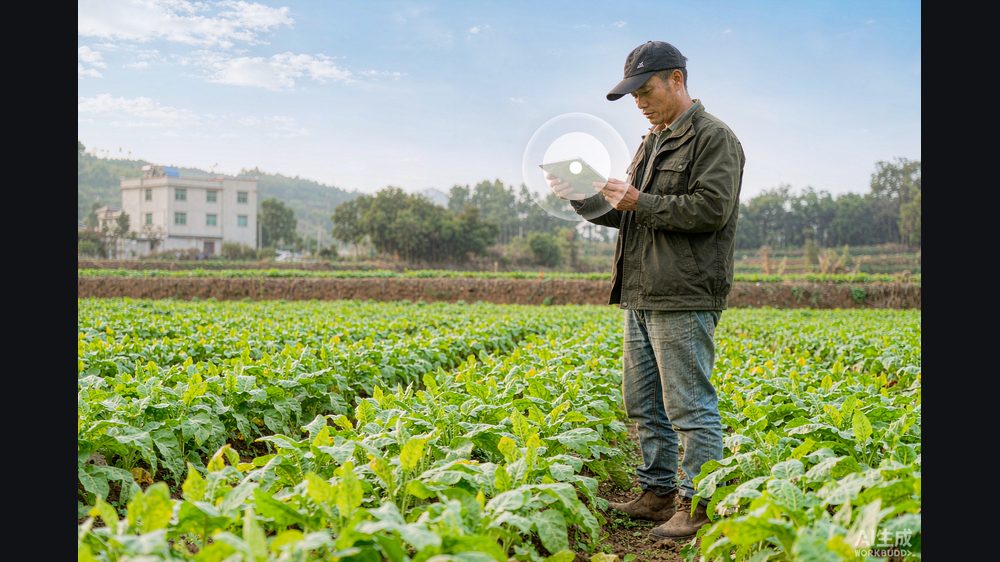
Frontier model announcements get the headlines. The deployment that changes daily life for hundreds of millions of people looks like an agricultural model telling a farmer when to fertilise.
Key takeaways
- Agriculture: the "Tiangong Kaiwu" (天工开悟) agricultural large model — described as the first to cover the entire agricultural production chain — has been extended to more than 100 farms, with reported average yield gains of 5% and production cost reductions of 10% in adopting areas.
- Breeding: at the Yazhou Bay National Laboratory in Sanya, Hainan, algorithm models screen vast genomic combinations to identify optimal crosses, replacing trial-and-error with targeted matching.
- County healthcare: AI multimodal diagnostic support systems deployed in county hospitals are reported to give patients imaging screening quality comparable to top-tier urban hospitals — without travelling to one.
- Public services: smart assistance systems in government service halls cover high-frequency procedures including social security and household registration, with intelligent form-filling and document pre-review.
- Logistics: intelligent dispatch systems match supply and demand in real time, with minute-level delivery of everyday goods reported in Chinese cities.
Why agriculture is the hard case
Agriculture is where AI adoption usually fails globally: margins are thin, connectivity is poor, users are not technical, and every field is different.
That is precisely why the numbers matter. A 10% production cost reduction in farming is not a tech-sector efficiency gain — for a sector operating on single-digit margins, it is the difference between a viable and a marginal season.
The breeding work in Sanya is the longer-horizon version of the same bet. Conventional crop breeding is a search problem across an enormous combinatorial space, and it has historically been limited by how many crosses a team can physically test. Models that rank candidate combinations before anyone plants them compress a decade of field trials into a season of targeted work.
China's policy framing treats smart agriculture as core to building an agricultural power, coordinating policy, projects, technology and extension services. The reported pattern — smart farms, ranches and fisheries taking root nationally — is consistent with the "AI+" adoption targets for 2027.
Healthcare at the county level
The structural fact of Chinese healthcare is that the best specialists are in a handful of cities and the patients are everywhere. AI's highest-value application is therefore not replacing specialists but exporting their judgement.
Three mechanisms are in deployment:
- Imaging support in county hospitals. Multimodal diagnostic assistance gives local radiologists a second reader, targeting the missed-finding rate that drives referrals.
- Rare disease triage. Xinhua Hospital's DeepRare system, reported with 57.18% first-diagnosis accuracy, cut the average rare-disease confirmation time at county hospitals from five years to about three weeks.
- Elderly care robotics. Beijing's Yizhuang district opened what is described as the world's first smart eldercare robot station, deploying more than 40 robot products across smart kitchens, rehabilitation therapy, day care and home adaptation, with continuous monitoring.
The third case points at a demographic reality rather than a technology one. Any society ageing as fast as China's has to automate care or ration it.
Public administration
The least discussed deployment is government service halls, and it may have the highest ratio of benefit to sophistication. AI pre-review of social security and household registration paperwork does not require a frontier model. It requires reliable document understanding — and it removes a category of friction that falls hardest on the least digitally fluent citizens.
Similarly, on Jiangsu's waterways, vessel lock systems now share data between "ship and lock" and "lock and lock", so a single declaration carries a vessel through every lock on a route, with passage plans generated automatically and pushed to the vessel. On Hunan's expressways, a "vehicle-road-cloud" agent issues forced pop-up and voice warnings for collapses, roadworks and accidents.
The honest framing
None of this is dramatic, and that is the point. Deployments that reach county hospitals and small farms are invisible in technology coverage but are the difference between AI being a sector and being infrastructure.
The genuine open question is consistency: whether every county hospital gets the system, or a hundred do. Chinese policy documents list uneven data circulation and compute supply among the constraints — an acknowledgement that the gap is organisational, not algorithmic.
Cases and figures as reported by the Cyberspace Administration of China, Xinhua, and the National Information Center in 2026.